



If you’ve been bouncing between Airbnbs, coliving promos, and last-minute hotel deals, you already know the problem. Short stays are easy. Building a repeatable, affordable system for living well in one city for a month, then moving to the next, is much harder.
That’s where the best home exchange websites become more than a travel hack. For digital nomads, they can work like a second housing strategy. You keep one stable base, unlock longer stays in places you want to live, and stop treating accommodation like a fresh emergency every time you change countries. Done well, home exchange gives you more space, a kitchen, a real neighbourhood, and a much better shot at settling into local routines.
It’s not perfect. Some platforms are built for traditional family vacations, not people taking calls from Lisbon on Tuesday and searching for a month in Mexico City next quarter. Others have strong trust features but thin inventory in the cities nomads want most. A few are excellent if you own a beautiful second home and basically useless if you’re a renter or budget-conscious freelancer.
That’s why this list focuses on long-term usefulness, not just glossy listings. I’m looking at which platforms make sense for extended stays, flexible timing, city-hopping, and community fit. The question is not just “Can you swap homes?” It’s “Can you build a lifestyle around this?”
If you also mix exchanges with paid stays, keep an eye on vacation rental discounts to reduce the weeks when a swap doesn’t line up.
Membership cost: $220 per year

You line up a month in Madrid, then a few weeks in Mexico City, then try to sort out autumn in Lisbon without paying short-term rental prices every time. HomeExchange is usually the first platform worth checking because inventory solves a lot of problems early. As noted in Global Travel Clan’s review of home exchange websites, the platform has a very large international network, which is a significant advantage if you want home exchange to support an ongoing nomad routine instead of a single annual trip.
Why it works for nomads
HomeExchange works well for long-term planning because it gives you more than one way to make a stay happen. You can arrange a direct reciprocal swap, but the main advantage for many remote workers is GuestPoints. That system lets you stay in someone’s home without needing your dates to match theirs exactly. If a client project shifts by two weeks, that flexibility can save the whole plan.
The annual membership model also fits a repeat-use strategy better than platforms that charge heavy transaction fees each time. If you expect to use exchanges several times a year, the cost structure is simple and easier to justify.
A few things stand out in practice:
- Strong city coverage: It gives you a better shot at finding options in major nomad hubs and in smaller cities where you may want a slower month.
- Useful flexibility: GuestPoints help when you are city-hopping and cannot coordinate a perfect one-to-one exchange.
- Good fit for repeat users: The platform makes more sense the more often you use it.
| Pros | Cons |
|---|---|
| ✅ Easy-to-navigate and intuitive platform | ❌ Annual fees are on the higher side (starting from $220) |
| ✅ Includes access to an active Facebook member community | ❌ Better suited for traditional travelers than full-time remote workers |
| ✅ 500 GP welcome bonus in your first year | |
| ✅ Customer support available, including help with cancellations | |
| ✅ Coverage for property damage in case of non-compliance | |
| ✅ Ideal option for families and occasional trips |
What to watch for
Scale helps, but it does not remove competition. High-demand neighborhoods in Lisbon, Barcelona, Mexico City, or Bali still attract a lot of interest, especially for one-month stays that overlap with good weather or school holidays. If your plan depends on one exact area and one exact set of dates, expect friction.
It also rewards members who participate seriously. A polished profile, quick replies, clear house details, and some flexibility on timing all improve your odds. HomeExchange is less passive than booking an apartment on demand. That trade-off is worth it for many nomads, but it is still a trade-off.
One more practical point. HomeExchange is strongest when you treat it as a system, not a last-minute search tool. Members who get the best results usually plan farther ahead, build credibility, and stay open to neighbourhoods that are good enough rather than perfect.
For month-long exchanges, send requests earlier than feels necessary. The best listings in popular cities are often claimed by members who plan one or two seasons ahead.
2. People Like Us

You find a great apartment in a city where you want to spend five or six weeks, then notice the key decision is not the photos. It is whether the other member will communicate well, answer practical questions, and feel comfortable hosting someone who plans to work from their home every day. People Like Us is built for that part of the exchange.
The platform has a more community-driven feel than the biggest names. Members tend to participate, respond, and explain expectations with more care. For digital nomads, that matters most on longer stays, where small details decide whether a swap works. Wi-Fi reliability, workspace setup, guest routines, laundry access, noise, and building access all matter more in week three than on a short holiday.
People Like Us makes the most sense for nomads who treat home exchange as an ongoing housing strategy, not a one-off experiment. If you plan to rotate between a few regions each year, stay longer in each place, and build relationships with hosts and neighbourhoods, the smaller but more engaged community can work in your favor. You spend less time sorting through dead listings and more time having real conversations that help you judge fit.
The search tools also help with practical screening. Filters for the details that shape day-to-day living can save a lot of wasted messages, especially if you need a separate workspace, elevator access, pet acceptance, or a home that suits a family setup.
| Pros | Cons |
|---|---|
| Highly engaged and loyal home-sharing community | Listings may not always suit remote workers’ needs |
| Large global network with thousands of listings | Platform information can feel slightly confusing for some users |
| Rich in features and customization options, built with expertise | |
| Well-established and widely trusted within the home exchange space | |
| Multiple exchange options offering strong flexibility |
Membership cost: $149 per year (Free trial for 30 days)
Best use case
People Like Us is a strong choice for trust-first exchangers. It suits remote workers who prefer fewer, better conversations over mass outreach. It also fits nomads who are willing to be flexible on exact neighborhood or dates in exchange for a host who is responsive and realistic.
That trade-off is real.
You are not getting the broadest inventory in every major city. In return, you often get a more human exchange process, which becomes more valuable as your stays get longer and your accommodation needs get less generic.
Real trade-offs
- Better for relationship-driven exchanges: Good if you want active communication before you commit.
- Useful for longer stays: Strong fit for nomads who need clarity on work conditions, house routines, and neighborhood livability.
- Less forgiving of rigid plans: If you only want one high-demand area and fixed dates, your options can narrow fast.
The smaller inventory is the main limitation. In popular nomad cities, you may need to widen your search area or plan earlier than you would on a larger platform. I would not use People Like Us as my only option for a fast-moving city-hop with zero flexibility. I would use it as part of a longer-term exchange stack, especially if I wanted better host alignment and a stronger sense of community.
Direct platform link: People Like Us

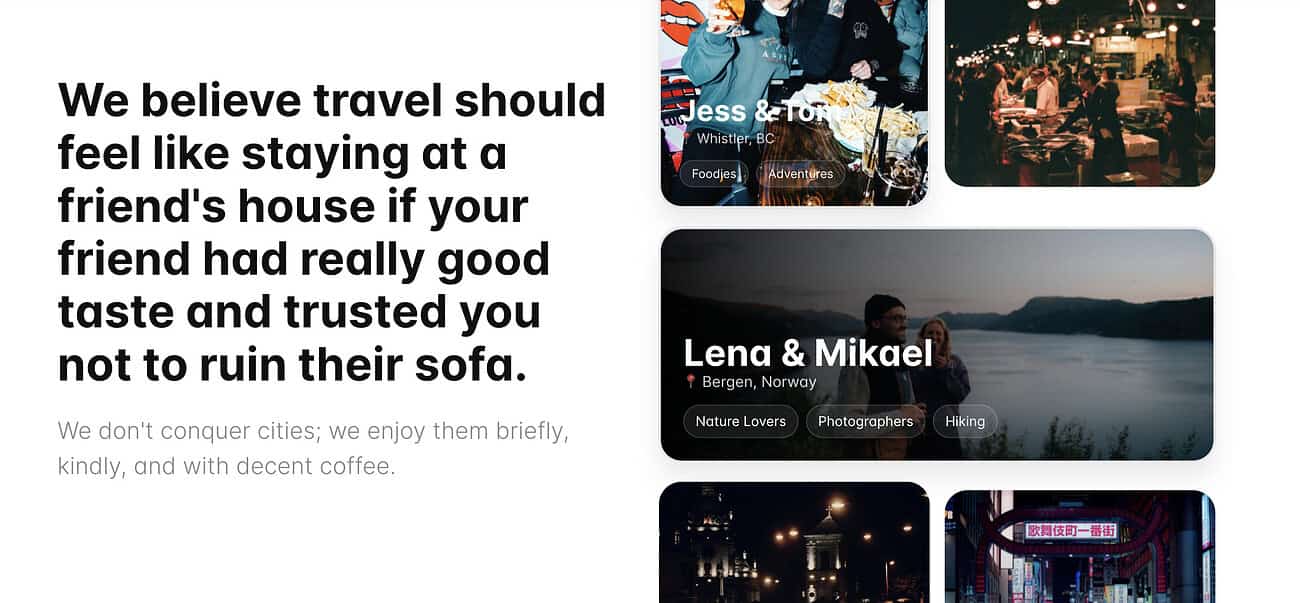

If home exchange platforms had a personality, Hoppswap would be the one that feels a bit like a dating app — but for travel. Everyone’s already packed, and instead of swiping on people, you’re matching with homes (and the people behind them).
At its core, Hoppswap is a home swapping platform that lets you stay in other people’s homes around the world — without paying nightly accommodation fees. You can either swap homes directly with another member or host guests to earn “nights”, which you can then use to stay somewhere else later. That flexibility makes it much easier to travel, even if you don’t have a perfectly aligned swap.
What makes Hoppswap stand out is how personal and preference-driven it feels. This isn’t just about finding any place to stay — it’s about finding the right match. You can filter based on things that actually matter to you: lifestyle, interests, home features, and location. In a way, you’re matching with like-minded people as much as you are with their homes.
The platform also keeps things simple and transparent. There are no nightly rates, no surprise costs per booking, and swaps are generally unlimited once you’re a member. Instead, you pay an annual subscription fee, which gives you access to the network, along with features like ID verification and basic insurance coverage for peace of mind.
Hoppswap feels modern, flexible, and more intentional than traditional home exchange sites — especially if you care about who you’re swapping with, not just where you’re staying.
| Pros | Cons |
|---|---|
| ✅ More personal, match-based experience (like a travel dating app) | ❌ Smaller community compared to established platforms |
| ✅ Flexible system with indirect swaps using nights | ❌ Fewer listings in some destinations |
| ✅ No nightly fees once you’re a member | ❌ Still building trust and long-term reputation |
| ✅ Modern, intuitive platform design | ❌ Matching approach can take longer than instant booking-style platforms |
| ✅ Unlimited swaps for frequent travelers | ❌ Not always optimized for remote work setups |
Direct platform link: Hopp Swap
Membership cost: $130/year

Intervac International is one of the old-school names in this space. That heritage matters because home exchange still runs on trust, and older networks often attract members who treat swapping more like a relationship than a transaction.
Why some nomads will love it
If you prefer slower travel, longer planning windows, and direct communication with members who are used to traditional exchanges, Intervac is worth a look. It tends to suit people who want to settle into one place for a while rather than bounce every week.
The regional representative model is another plus. When a platform has people helping locally, it can be easier to manage first swaps, awkward misunderstandings, or country-specific expectations around hosting.
A few strengths stand out:
- Good for traditional exchangers: Better if you like clear mutual arrangements.
- Helpful for slower itineraries: Works best when you plan ahead.
- Appealing if you value human support: Regional help can matter more than slick product design.
Where it lags
The interface feels older, and that affects daily use. Search, messaging, and listing presentation matter when you’re comparing multiple homes and trying to decide whether one place can support a work month. Newer platforms often do this better.
Inventory density can also be uneven depending on where you want to go. If your entire nomad map revolves around a tight list of urban hubs, Intervac may feel limiting.
Still, if you’re the kind of traveler who wants reliable communication and does not need an app-like experience, Intervac stays relevant.
| Pros | Cons |
|---|---|
| ✅ Well-suited for backpackers, young travelers, and families | ❌ Interface feels a bit outdated compared to newer platforms |
| ✅ Great option for short trips and occasional stays | ❌ Not always ideal for remote work (workspace/WiFi can vary) |
| ✅ Advanced filters make it easy to refine your search | |
| ✅ Trusted platform with a strong reputation in the community | |
| ✅ One of the more affordable membership options |
Direct platform link: Intervac International
HomeLink appeals to a very specific type of nomad. Not the person trying to book next week. Not the person optimizing every stay with filters and automation. It’s better for someone who values longstanding exchange culture, local chapter support, and straightforward simultaneous swaps.
According to the verified data, HomeLink was established in 1953 and has over 70 years of history. It is also described in the same dataset as having 14,000 homes in 80 countries, which shows both its credibility and its limits compared with larger modern networks.
What HomeLink gets right
The strongest feature is support structure. Local coordinators and country chapters can be reassuring, especially if you’re newer to exchanging or you prefer to talk through details before agreeing to a stay.
This kind of model often attracts members who are committed to the process. That can lead to better communication and fewer flaky interactions than you sometimes see on fast-growth platforms.
It also works for travelers who like the old model of swapping as a mutual arrangement between households, not a credit game.
What nomads need to watch
The main issue is fit. Many digital nomads need non-simultaneous options, city flexibility, and enough inventory to move around without waiting months for the perfect match. HomeLink can feel narrower on all three.
There is also a legal and regulatory angle worth taking seriously. The verified data notes that home exchange viability in high-regulation nomad hotspots is often under-addressed, including questions around subletting violations and insurance gaps, especially in visa-strict or highly regulated markets, as highlighted in HomeLink-related background on homelink.org. That does not make HomeLink uniquely risky. It means you should verify building rules, lease terms, and insurance before any exchange.
- Best for traditional simultaneous swaps: Stronger if your dates line up clearly.
- Best for trust-first users: Good if chapter support matters to you.
- Less ideal for aggressive city-hopping: Smaller inventory makes constant movement harder.
| Pros | Cons |
|---|---|
| ✅ Works well for both short getaways and longer stays | ❌ Limited listings outside Europe, the US, and Oceania |
| ✅ Recently updated interface that’s easier to use | ❌ Not always a great fit for remote workers or digital nomads |
| ✅ Budget-friendly membership with reliable customer support | |
| ✅ Strong appeal for families, including child exchange opportunities | |
| ✅ Popular among seasoned home exchange users |
Direct platform link: HomeLink

You are planning a month in Aspen, Marbella, or Napa. You want a polished second home, not a spare bedroom with decent Wi-Fi and good intentions. THIRDHOME serves that buyer.
This platform sits in a different category from the exchange sites that make sense for most digital nomads. It is a private club built around high-end second homes and a Keys-based system, with pricing and membership standards that screen for a wealthier owner base. As noted earlier from Digital Nomads World’s market overview, THIRDHOME belongs to the luxury end of home exchange, not the budget or mainstream segment.
That distinction matters if you are building a long-term nomad setup.
For a founder, investor, or remote operator with access to a qualifying property, THIRDHOME can work well as a lifestyle platform. The upside is clear. Better curation, more predictable quality, and a member pool that usually expects a higher standard of communication and property care. If your travel style includes longer stays in resort markets or affluent seasonal destinations, that narrower focus can be useful.
For most nomads, the trade-off is simple. The fees are higher, the inventory is shaped around luxury leisure travel, and the platform is a poor fit for frequent city-hopping. You are not using THIRDHOME to string together a cost-efficient year across Lisbon, Mexico City, Chiang Mai, and Buenos Aires. You are using it to access premium homes in destinations where quality matters more than cost control.
That makes THIRDHOME less of a core nomad tool and more of a niche option. It can complement a broader accommodation strategy if you already have the right asset base. It rarely replaces the more flexible platforms that support regular movement, non-simultaneous exchanges, and everyday remote work.
- Best for luxury second-home owners: Stronger if you want curated properties and a gated member base.
- Useful for occasional premium stays: Better as a selective add-on than an always-on nomad system.
- Poor fit for budget-first long-term travel: Frequent fees and luxury positioning weaken the value for most remote workers.
Direct platform link: THIRDHOME
7. Kindred
Membership cost: Starting at $150/year
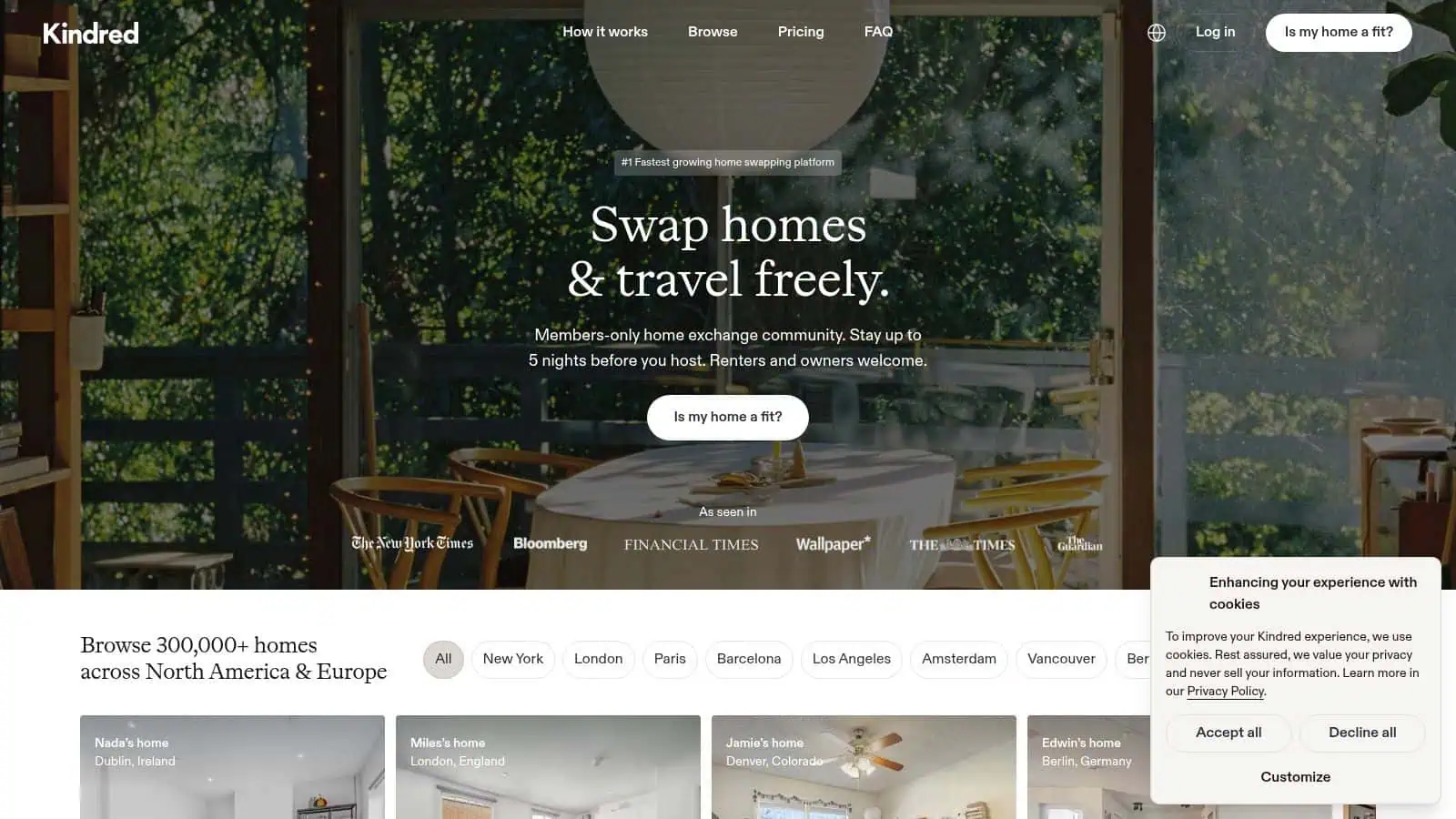
You line up a month in New York, a few weeks in San Francisco, then try to keep costs under control without falling into the usual short-term rental trap. Kindred is one of the few exchange platforms built for that kind of city-heavy plan.
Its appeal is practical. The product feels modern, the booking flow is cleaner than many legacy exchange sites, and the platform puts more structure around the parts that usually create friction, especially cleaning, support, and non-simultaneous stays. As noted earlier in the article, Kindred is also part of the newer wave of exchange platforms targeting budget-conscious remote workers.
Why it works for nomads
Kindred fits a specific use case well. It helps remote workers test expensive cities without paying full market rent every time, and it lowers the coordination burden that makes traditional swapping hard to sustain over multiple moves.
That matters if home exchange is part of a long-term nomad system rather than a once-a-year holiday tool.
A few strengths stand out:
- Cleaner operations: Standardized cleaning processes reduce the back-and-forth that often slows down exchanges.
- Better for non-simultaneous travel: The credit model gives you more flexibility if your travel calendar does not line up neatly with another member’s.
- Stronger urban appeal: It tends to make the most sense in major cities where hotel and rental prices punish short test stays.
- Accessible to more members: Renters can often participate, which opens the door for nomads who do not own property.
Where the trade-offs show up
Kindred is not the cheapest option once you start stacking service and cleaning fees across multiple stays. For a one-off month in an expensive city, that can still be a good trade. For a full year of frequent movement, the math needs a closer look.
I would use Kindred for trial runs in places where I might want a longer base later. It is a strong platform for city-hopping in higher-cost markets, especially if convenience and time savings matter to you. I would be more cautious about building an entire low-budget, slow-travel strategy around it unless the fee structure still beats local rentals in the places you want to live.
| Pros | Cons |
|---|---|
| ✅ No membership fees to join the platform | ❌ Service fees can make short stays or budget destinations less worthwhile |
| ✅ Strong focus on safety with vetted members and built-in protections | ❌ Limited availability mainly in Europe and North America |
| ✅ Clean, modern, and visually appealing interface | ❌ Booking isn’t instant and usually requires 1–2 days for host approval |
| ✅ Dedicated mobile apps for both iOS and Android | |
| ✅ Highly responsive and reliable customer support | |
| ✅ Ideal for saving money on longer stays in expensive cities |
Direct platform link: Kindred
8. Behomm

Behomm is the niche pick. It is curated, design-led, and selective. If mainstream exchange sites feel too random, Behomm offers a very different experience.
Why some remote workers love it
This platform attracts creatives, designers, architects, and people who care about the quality of the space they live in. For a nomad, that can matter more than aesthetics alone. A thoughtfully designed home usually signals something useful, comfort, intention, and hosts who pay attention.
That often translates into better desks, better kitchens, calmer neighborhoods, and homes that feel livable for more than a weekend.
The trust dynamic also changes when the network is curated. You are dealing with a smaller group of members who joined for a specific community, not just cheap accommodation.
Why it is not a universal recommendation
Curation limits scale. That’s the core trade-off. If you need broad inventory, lots of destination choice, or quick match odds in mainstream nomad hubs, Behomm can feel restrictive.
It also works best if you fit the culture. Some people will love that. Others will find it unnecessary.
I’d recommend Behomm for slow travelers who care about space quality as much as destination. If your accommodation affects your mood, focus, and work output, a smaller but better-curated network can beat a giant platform full of average options.
Direct platform link: Behomm
9. Home Base Holidays

Home Base Holidays is the practical low-cost option. It does not feel flashy, and that is part of the appeal. Some nomads do not need a heavily engineered product. They need a straightforward site where they can test swapping without overcommitting.
Best for occasional use
If you travel in chunks instead of continuously, this platform is easier to justify. The free trial and low-cost structure lower the pressure to become a power user.
It is also a decent match for people who want classic arrangements and don’t care whether the interface feels modern. Some remote workers overvalue product polish and undervalue simple member-to-member communication. Home Base Holidays reminds you that old-fashioned can still work.
A few reasons it earns a place on this list:
- Easy to test: Free trial lowers the barrier.
- Good for occasional swappers: Better value if you do not need a premium ecosystem.
- Useful backup platform: Worth keeping in your mix for extra destination coverage.
The limitation
Inventory is smaller than the major players. For digital nomads, that usually means fewer obvious wins in high-demand urban markets. It is better as a secondary account or a lower-cost experiment than as the backbone of a fully mobile lifestyle.
If you are comparing the best home exchange websites purely on scale, it will not lead. If you are comparing them on low-risk entry and simplicity, it holds up well.
Direct platform link: Home Base Holidays
10. Holiday Swap
Holiday Swap takes a more mobile-first approach than most of the category. That changes the feel immediately. Browsing, messaging, and booking are more app-centric, which can suit nomads who make quicker accommodation decisions and manage travel from their phone.
Where it fits best
This is more useful for spontaneous plans, shorter trips, and people who like token-based systems. If your style is “finish a month in one base, then jump somewhere nearby for a quick reset,” the mobile-first experience can be a genuine advantage.
It is also easier for users who do not want a heavy community onboarding process. Some traditional exchange sites ask for more patience and more relationship-building before you get value. Holiday Swap aims for speed.
Where it falls short
The downside is consistency. App-centric platforms can vary a lot by destination, listing quality, and pricing structure. That makes it harder to rely on Holiday Swap as your primary long-term nomad housing tool.
It’s better as a tactical option than a core system. I’d use it for short gaps, spontaneous city breaks, or quick transitions between larger bases. I would not build my whole accommodation strategy around it unless the destinations you care about already have reliable depth there.
For many remote workers, that is still useful. Not every platform needs to do everything.
Direct platform link: Holiday Swap
Top 10 Home Exchange Websites Comparison
| Platform | Core features ✨ | UX & quality ★ | Price / Value 💰 | Target audience 👥 | Unique edge 🏆 |
|---|---|---|---|---|---|
| HomeExchange | ✨ Unlimited annual swaps, GuestPoints for non‑reciprocal, 150+ countries, host protection | ★★★★☆ | 💰 Flat annual fee, unlimited exchanges | 👥 Frequent home‑swappers & families | 🏆 Largest global inventory & predictable costs |
| People Like Us | ✨ Reciprocal + credit system (Globes/Plutos), 150+ filters, Premium unlimited | ★★★★ | 💰 Affordable annual Premium; 60‑day guarantee | 👥 Community‑focused swappers | 🏆 Strong community + effective discovery tools |
| Love Home Swap | ✨ Reciprocal & points‑style non‑simultaneous swaps; pay‑after‑first‑swap onboarding | ★★★ | 💰 Pay after first swap; integrated with HomeExchange | 👥 New swappers wanting low friction | 🏆 Very low‑friction onboarding experience |
| Intervac International | ✨ Traditional reciprocal swaps, regional reps, 21‑day trial, 1–2yr plans | ★★★ | 💰 Budget‑friendly plans + free trial | 👥 Traditional/long‑stay exchangers | 🏆 One of the oldest, with regional human support |
| HomeLink | ✨ Country chapters, simultaneous swaps, local coordinators | ★★★ | 💰 Lower entry costs; chapter support | 👥 Trust‑oriented members & retirees | 🏆 Strong local chapter network and personal contact |
| THIRDHOME | ✨ Curated luxury homes, Keys currency, member associates, fee grid | ★★★★★ | 💰 Gated membership + per‑stay exchange fees | 👥 Luxury second‑home owners & upscale travelers | 🏆 High‑end, consistently vetted luxury inventory |
| Kindred | ✨ Credit give‑to‑get model, centralized cleaning & trip support | ★★★★ | 💰 Membership + per‑stay cleaning/service fees | 👥 Urban nomads & city‑centric travelers | 🏆 Concierge‑style urban swaps with standardized cleaning |
| Behomm | ✨ Invite/application only, design‑led curated homes, reciprocal swaps | ★★★★ | 💰 Application/invite model; modest fees | 👥 Creatives, designers & aesthetic seekers | 🏆 Highly curated, design‑forward member community |
| Home Base Holidays | ✨ Free trial, low‑cost 6/12‑month plans, “no‑swap” extra‑year guarantee | ★★★ | 💰 Very low price point; great for occasional users | 👥 Budget families & retirees testing swapping | 🏆 Best value for low‑frequency exchangers |
| Holiday Swap | ✨ Mobile‑first app, token credit system, Premium unlimited tier | ★★★ | 💰 Premium subscription + token costs; app pricing varies | 👥 Spontaneous short‑trip travelers & mobile users | 🏆 Mobile‑centric, easy discovery for quick getaways |
Final Thoughts
The best home exchange websites are not interchangeable. That’s the biggest mistake I see when people first try to use swapping as part of a digital nomad lifestyle. They assume every platform solves the same problem, then sign up for one that looks popular and wonder why it doesn’t fit the way they travel.
If you want one broad recommendation, HomeExchange is still the strongest default for many individuals. Its scale, flexibility, and annual-fee model make it the easiest platform to build around if you plan to travel often and want a realistic shot at finding stays in multiple countries across the year. It is the closest thing to a general-purpose exchange platform for nomads.
If trust and community matter more to you than pure inventory size, People Like Us stands out. It feels more relational, and that can lead to better exchanges if you like talking details through before committing. Kindred is the strongest choice for people who want a cleaner, more modern product experience and mostly care about city-based travel. It feels especially relevant for remote workers who bounce between major urban hubs and want less operational friction.
The older networks still have value. Intervac and HomeLink appeal to people who prefer traditional exchange culture, local support, and slower planning cycles. They are not the best fit for every nomad, but they can work well if your style is less spontaneous and more intentional. Behomm is the niche choice for design-conscious slow travelers. THIRDHOME is clearly for the luxury segment. Home Base Holidays and Holiday Swap are useful depending on whether you want lower-cost experimentation or mobile-first spontaneity.
The practical playbook is simple.
Start with one primary platform. Add one secondary platform that covers a different weakness. For example, pair a large general network with a more community-driven or city-focused option. Keep your profile detailed. Be honest about your workspace, internet, noise level, and house rules. Search by neighborhood, not just city. Treat messaging like a real conversation, not a booking request. And always think in terms of months, not just single trips.
There’s also one issue many guides skip. Legal and building rules matter. In some destinations, especially highly regulated nomad hubs, your lease, HOA rules, building policies, host permissions, or insurance can matter just as much as platform trust features. Before any exchange, make sure the arrangement is allowed and properly covered. Cheap accommodation is not worth stress with a landlord, property manager, or local authority.
Used well, home exchange can reduce accommodation costs, improve your day-to-day living quality, and make long-term travel feel more stable. It won’t replace every hotel, Airbnb, or coliving stay. It doesn’t need to. The key advantage is that it gives you another strong option, one that often works better for life on the road than short-term rentals built for tourists.
For nomads who want homes instead of units, neighborhoods instead of districts, and longer stays without constant price shock, home exchange is worth learning properly.
If you’re building a location-independent life and want more practical guidance on accommodation, visas, gear, destinations, and the systems that make long-term travel sustainable, check out Remote Tribe. It’s one of the better resources for remote workers who want useful advice, not just dream-sell travel content.
