


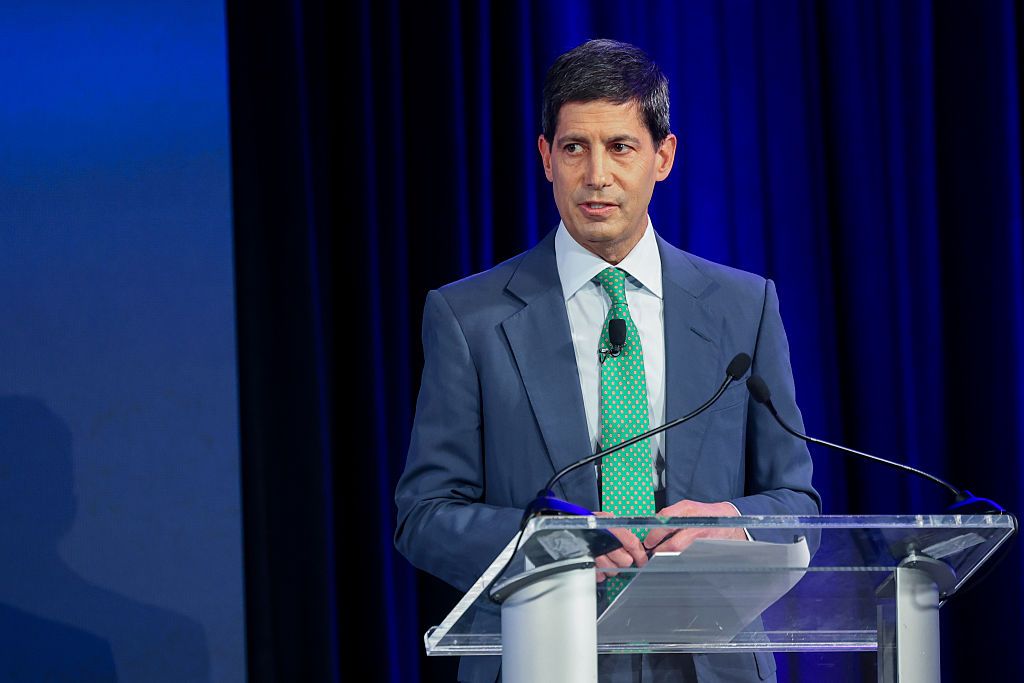

(Image credit: Tierney L. Cross/Bloomberg via Getty Images)
Who knew that monetary policy could be so exciting? The way the Federal Reserve Bank sets interest rates and manages the money supply might prompt some terse words among economists or some raised voices on CNBC, but it typically creates little controversy outside financial circles.
As with many things in the Trump administration, however, the president’s nomination of financier, lawyer and former Fed governor Kevin Warsh to replace Jerome Powell in May has been mired in high drama.
Warsh, 55, is currently a lecturer at Stanford University and a partner in the family office that manages billionaire Stanley Druckenmiller’s fortune. He served as a Federal Reserve governor from 2006 to 2011 after President George W. Bush made him, at 35, the youngest-ever appointee. A former Morgan Stanley executive and a Harvard-educated attorney, Warsh was credited by Ben Bernanke for his Wall Street savvy as the Fed navigated the Great Financial Crisis that started in 2008.
Sign up for Kiplinger’s Free Newsletters
Profit and prosper with the best of expert advice on investing, taxes, retirement, personal finance and more – straight to your e-mail.
Profit and prosper with the best of expert advice – straight to your e-mail.
That résumé may sound par for the course — President Donald Trump called it “central casting.” But even assuming Warsh wins Senate confirmation, it is safe to say that this is not the typical Fed-chair transition.
Trump’s rhetoric and his administration’s actions have raised the specter of a level of political interference in monetary policy that’s unprecedented in the modern history of the central bank. And as if that weren’t enough, the transition to a new Fed chair comes at a time when a mulligan stew of mixed economic indicators makes the Fed’s next course of action with interest rates anything but clear. In short, the selection of Kevin Warsh as the next Fed chair may be the most consequential in decades.
Looking for more timely stock market news to help gauge the health of your portfolio? Sign up for Closing Bell, our free newsletter that’s delivered straight to your inbox at the close of each trading day.
A hundred years and counting
The Federal Reserve system as we mostly know it today started in 1913 after decades of fits and starts in establishing a national bank. It had its successes and failures, with the Great Depression notable in the latter category. A 1951 agreement between the Fed and the Treasury Department freed the Fed to use monetary policy to control inflation.
In 1977, an act of Congress directed the Fed to also use its policies to maximize employment, in addition to fighting price increases. This is called its dual mandate, because the two aims can be contradictory. Few other of the world’s central banks try to achieve both goals.
Right now, the Trump administration seems intently, if not solely, focused on maximizing employment — and, if the president’s social media posts are an indication, boosting stock prices. That policy would call for lower interest rates and is described as dovish in monetary-policy terms. The opposite approach, raising interest rates to slow down the economy and cut inflation, is called hawkish. The Warsh pick is curious, many say, because he has more of a track record of hawkishness than the other candidates Trump considered.
During his time as governor, Warsh repeatedly expressed concerns about inflation. After leaving the Fed, he criticized the central bank’s policy of increasing the money supply for years after the financial crisis via a massive bond-buying program known as quantitative easing. That policy stoked economic demand and contributed to inflation. However, Warsh has recently expressed the view that lower rates are appropriate right now. He has been arguing that productivity gains from artificial intelligence mean the U.S. can have lower rates without risking a jump in inflation.

(Image credit: Getty Images)
William Merz, head of capital markets research at U.S. Bank Asset Management, says Warsh has repeatedly said the Fed needs to intervene less in the economy, unless there is a crisis, and make fewer public comments. “I think there’s probably an underappreciation for the extent to which Warsh believes the Fed is in need of significant reform,” says Merz.
As Fed chair, Warsh would yield tremendous power. But ultimately, he would be just one of 12 votes on the Open Market Committee, the Fed’s rate-setting body. The seven governors are joined by five of the regional Federal Reserve Bank presidents, four of whom rotate in and out each year.
“I think Warsh is seen as more credible, more independent,” says Idanna Appio, portfolio manager of the Global Income Builder Fund at New York City–based asset management firm First Eagle Investments. “I think he has a better chance of bringing the rest of the committee along.”
A consensus of current forecasts calls for no more rate cuts during Powell’s tenure, through May, and the potential for one to two cuts in the remainder of 2026. That may shift depending on how the market comes to view Warsh’s nomination.
It’s also important to note that a cut in the fed funds rate doesn’t necessarily translate into lower long-term rates, including mortgage rates, which tend to take their cues from the bond market. If bond traders see Fed rate cuts as the first step toward overheated markets and more inflation, they’re likely to sell off long-term debt, causing long-term bond yields to rise, not fall.
A question of independence

(Image credit: Getty Images)
Trump put Powell in the position of Fed chair in February 2018 but has repeatedly maligned him for a failure to cut interest rates more quickly. In mid-January, Trump said Powell “either is incompetent or he’s crooked,” and said, “That jerk will be gone soon.” (Powell’s term as a Fed governor does not end until January 2028; he has not said whether he intends to stay on in that role.)
Trump’s comments came after Powell issued an extraordinary statement confirming that the Department of Justice had launched a criminal investigation of him. Although the DOJ is scrutinizing Powell’s congressional testimony regarding the cost and extent of a renovation of the bank’s headquarters, Powell said the threat of criminal charges is a consequence of the Fed “setting interest rates based on our best assessment of what will serve the public, rather than following the preferences of the president.”

(Image credit: Getty Images)
“I’m not going to sugarcoat it — trying to threaten the independence of the world’s most powerful central bank is a problem,” says Liz Ann Sonders, the chief investment strategist at the Schwab Center for Financial Research. “It’s not bombastic to say that we’d be in a world of hurt if somehow any administration was able to wrest control over monetary policy decision-making — and that should not be seen as a partisan statement.”
Powell’s successor will have to live up to a legacy that has grown in some quarters as Powell has stood up to Trump’s exhortations. “I think we’re very fortunate to have someone like Jerome Powell in the role of chair at the moment,” says David Doyle, head of economics at Australian financial firm Macquarie Group.
But the experts we interviewed also acknowledged the blemish on his record: the failure to contain the post-pandemic inflation that gave Americans their first taste of sharply rising prices in four decades. Powell and the Fed get credit, however, for acting decisively once the problem became clear.
“A lot of people who want to criticize Powell will point to how inflation got out of hand in 2022 and how the Fed was a little bit late to recognize that inflation wasn’t transitory,” says Chris Zaccarelli, the chief investment officer of Charlotte, N.C.–based Northlight Asset Management. “However, once they did recognize their mistake, they moved quickly to raise interest rates, got inflation much more under control and, surprisingly, were able to engineer all of that without causing a recession.”
Doyle says the pandemic and the associated shutdown were “hopefully a once-in-a-century event. I think that was tough for anyone to have gotten right.”
The challenge today
No such crisis exists now — but in a way, that makes it harder to chart a course. On the one hand, inflation has been above the Fed’s 2% objective for nearly five years. On the other, there’s a host of weak economic indicators, including employment numbers, consumer sentiment and manufacturing activity.
“When we have a recession or when we have very high inflation, the policy outlook is very clear. What we have here is a little more nebulous, which is inflation that is slightly above comfort levels and growth that is slightly below,” says Frances Donald, the chief economist at Royal Bank of Canada. “It is exactly the type of environment that creates a significant debate over the next move.”
That, more so than an ideological divide, might explain the recent, unusual split votes within the Open Market Committee. In the December meeting, three of the 12 members dissented from the decision to lower the target range for the federal funds rate, the rate banks charge each other for loans, by 0.25 percentage point, to 3.5% to 3.75%. One member wanted a bigger cut, while two preferred to make no change at all.
In the January meeting, Christopher Waller, who was also considered for the chairmanship, and another governor wanted cuts when the committee held steady. “You have to go back decades in order to see that many dissents amongst voting members,” says Zaccarelli. “It’s completely reasonable to have differing opinions on the exact same data given that the future forecast looks a little muddier.”
Investors, for their part, might want to buckle up. According to Daniel Siluk, a portfolio manager at U.K.-based Janus Henderson Investors: “Whenever a new Fed chair steps in, interest rate volatility often jumps higher as markets adjust to the fresh communication style and initial policy signals. There’s a brief period of uncertainty, and overreaction, until the new chair finds their footing.” Stocks fell slightly, bond yields were mainly steady overall, and the dollar rose on the day of Warsh’s nomination.
In the meantime, outgoing chair Powell has some advice for his successor: “Stay out of elected politics,” he said at the press conference following the January Open Market Committee meeting. “Don’t get pulled into elected politics. Don’t do it.”
Note: This item first appeared in Kiplinger Personal Finance Magazine, a monthly, trustworthy source of advice and guidance. Subscribe to help you make more money and keep more of the money you make here.
