

Close Menu
Finsider

    Subscribe to Updates

    Get the latest creative news from FooBar about art, design and business.

    What's Hot

    Love autocomplete in your texts? Research says its quietly changing your thoughts

    March 12, 2026

    Google is using old news reports and AI to predict flash floods

    March 12, 2026

    Is Venmo Safe to Use for Free Transactions?

    March 12, 2026
    Facebook X (Twitter) Instagram
    Trending
    • Love autocomplete in your texts? Research says its quietly changing your thoughts
    • Google is using old news reports and AI to predict flash floods
    • Is Venmo Safe to Use for Free Transactions?
    • Investing Scams: How to Protect Yourself and Your Money
    • Are Cheap SSD Brands Actually Reliable? Here’s What Users Say
    • A stock market crash could be a massive passive income opportunity
    • Regional Immigration Agreements Shaping Global Mobility
    • Which is the better investment?
    Facebook X (Twitter) Instagram Pinterest Vimeo
    Finsider
    • Markets & Ecomony
    • Tech & Innovation
    • Money & Wealth
    • Business & Startups
    • Visa & Residency
    Finsider
    Home»Business & Startups»Google is using old news reports and AI to predict flash floods
    Business & Startups

    Google is using old news reports and AI to predict flash floods

    FinsiderBy FinsiderMarch 12, 2026No Comments3 Mins Read
    Share Facebook Twitter Pinterest LinkedIn Tumblr Reddit Telegram Email
    Google is using old news reports and AI to predict flash floods
    Share
    Facebook Twitter LinkedIn Pinterest Email

    Flash floods are among the deadliest weather events in the world, killing more than 5,000 people each year. They’re also among the most difficult to predict. But Google thinks it has cracked that problem in an unlikely way — by reading the news.

    While humans have assembled a lot of weather data, flash floods are too short-lived and localized to be measured comprehensively, the way the temperature or even river flows are monitored over time. That data gap means that deep learning models, which are increasingly capable of forecasting the weather, aren’t able to predict flash floods.

    To solve that problem, Google researchers used Gemini — Google’s large language model — to sort through 5 million news articles from around the world, isolating reports of 2.6 million different floods, and turning those reports into a geo-tagged time series dubbed “Groundsource.” It’s the first time that the company has used language models for this kind of work, according to Gila Loike, a Google Research product manager. The research and data set was shared publicly Thursday morning.

    With Groundsource as a real-world baseline, the researchers trained a model built on a Long Short-Term Memory (LSTM) neural network to ingest weather global forecasts and generate the probability of flash floods in a given area.

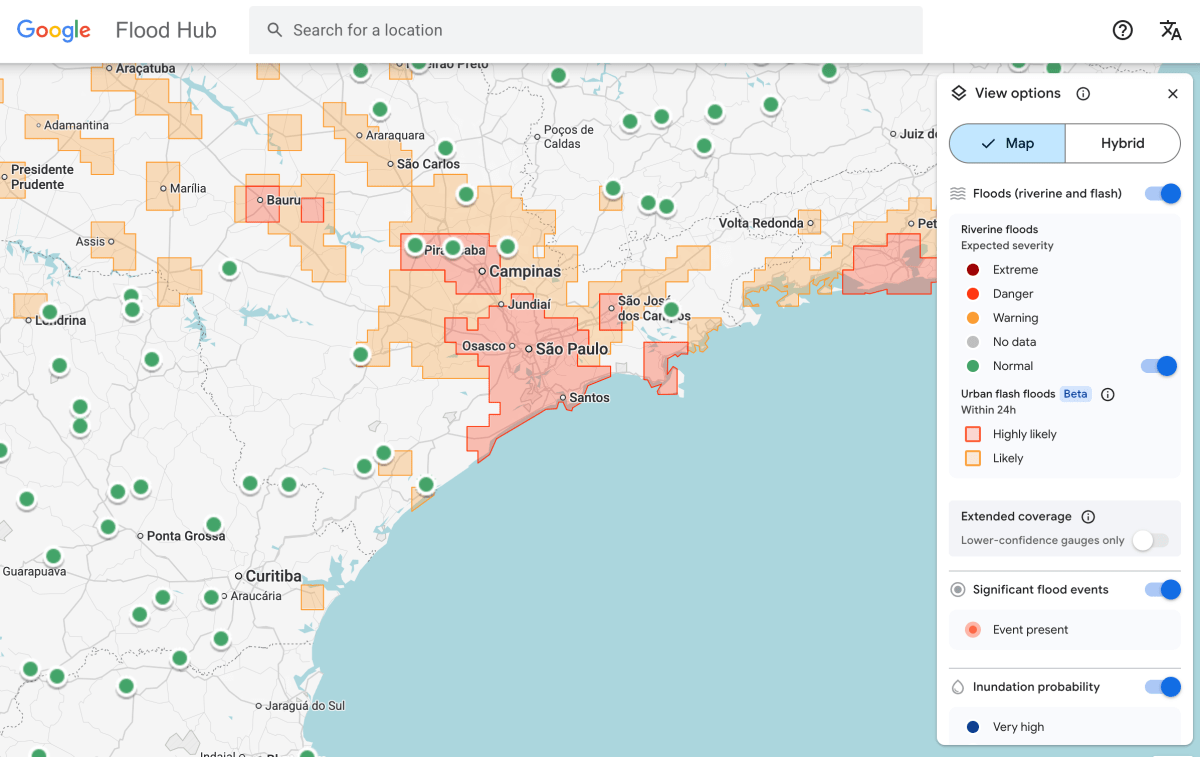
    Google’s flash flood forecasting model is now highlighting risks for urban areas in 150 countries on the company’s Flood Hub platform, and sharing its data with emergency response agencies around the world. António José Beleza, an emergency response official at the Southern African Development Community who trialed the forecasting model with Google, said it helped his organization respond to floods more quickly.

    There are still limitations to the model. For one, it is fairly low resolution, identifying risk across 20-square-kilometer areas. And it is not as precise as the US National Weather Service’s flood alert system, in part because Google’s model doesn’t incorporate local radar data, which enables real-time tracking of precipitation.

    Part of the point, though, is that the project was designed to work in places where local governments can’t afford to invest in expensive weather-sensing infrastructure or don’t have extensive records of meteorological data.

    Techcrunch event

    San Francisco, CA
    |
    October 13-15, 2026

    “Because we’re aggregating millions of reports, the Groundsource data set actually helps rebalance the map,” Juliet Rothenberg, a program manager on Google’s Resilience team, told reporters this week. “It enables us to extrapolate to other regions where there isn’t as much information.”

    Rothenberg said the team hopes that using LLMs to develop quantitative data sets from written, qualitative sources could be applied to efforts to building data sets about other ephemeral-but-important-to-forecast phenomena, like heat waves and mud slides.

    Marshall Moutenot, the CEO of Upstream Tech, a company that uses similar deep learning models to forecast river flows for customers like hydropower companies, said Google’s contribution is part of a growing effort to assemble data for deep learning-based weather forecasting models. Moutenot co-founded dynamical.org, a group curating a collection of machine learning-ready weather data for researchers and startups.

    “Data scarcity is one of the most difficult challenges in geophysics,” Moutenot said. “Simultaneously, there’s too much Earth data, and then when you want to evaluate against truth, there’s not enough. This was a really creative approach to get that data.”

    flash floods Google news predict Reports
    Share. Facebook Twitter Pinterest LinkedIn Tumblr Email
    Previous ArticleIs Venmo Safe to Use for Free Transactions?
    Next Article Love autocomplete in your texts? Research says its quietly changing your thoughts
    Finsider
    • Website

    Related Posts

    Tech & Innovation

    Google brings Gemini in Chrome to India

    March 11, 2026
    Business & Startups

    Slate Auto changes CEO months ahead of affordable EV launch

    March 9, 2026
    Business & Startups

    TechCrunch Mobility: Rivian’s R2 gambit

    March 8, 2026
    Add A Comment
    Leave A Reply Cancel Reply

    Top Posts

    Cursor snaps up enterprise startup Koala in challenge to GitHub Copilot

    July 18, 2025

    What is Mistral AI? Everything to know about the OpenAI competitor

    July 18, 2025

    Analyst Report: Kinder Morgan Inc

    July 18, 2025
    Stay In Touch
    • Facebook
    • YouTube
    • TikTok
    • WhatsApp
    • Twitter
    • Instagram
    Latest Reviews

    Subscribe to Updates

    Get the latest tech news from FooBar about tech, design and biz.

    Most Popular

    Using Gen AI for Early-Stage Market Research

    July 18, 2025

    Cursor snaps up enterprise startup Koala in challenge to GitHub Copilot

    July 18, 2025

    What is Mistral AI? Everything to know about the OpenAI competitor

    July 18, 2025
    news

    Love autocomplete in your texts? Research says its quietly changing your thoughts

    March 12, 2026

    Google is using old news reports and AI to predict flash floods

    March 12, 2026

    Is Venmo Safe to Use for Free Transactions?

    March 12, 2026

    Subscribe to Updates

    Get the latest creative news from FooBar about art, design and business.

    © 2020 - 2026 The Finsider . Powered by LINC GLOBAL Inc.
    • Contact us
    • Guest Post Policy
    • Privacy Policy
    • Terms of Service

    Type above and press Enter to search. Press Esc to cancel.