


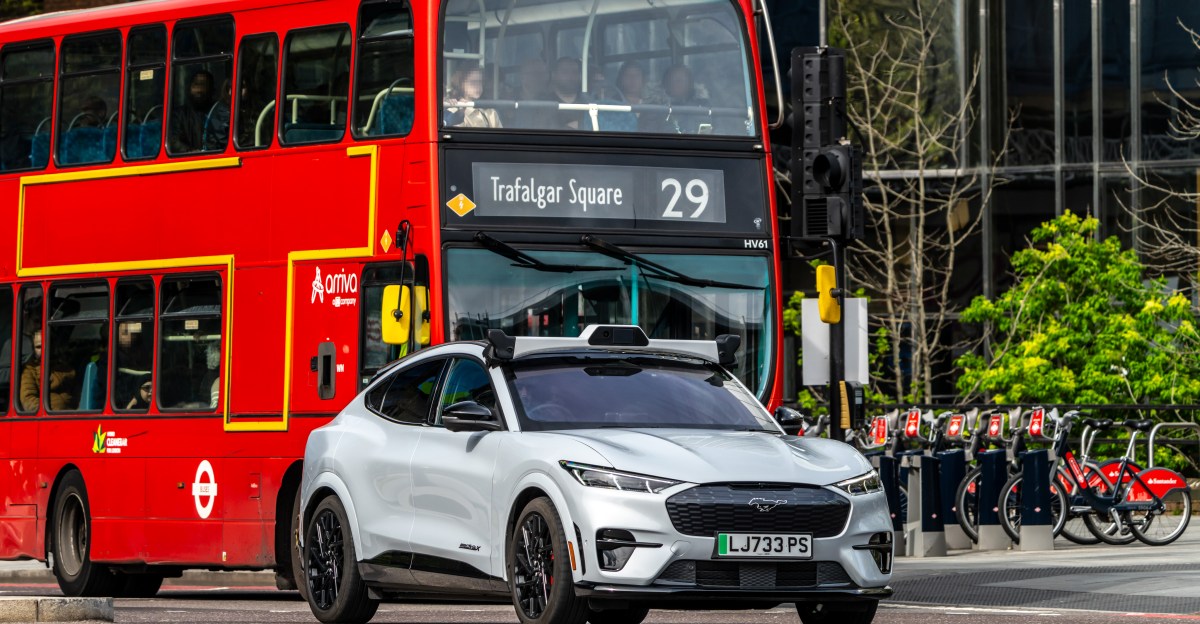
I never really believed self-driving cars would make it to the UK, so you can imagine my surprise when I found myself clambering into one of Wayve’s autonomous vehicles for a journey around north London a few weeks ago.
In June, the company announced plans with Uber to begin trialing Level 4 fully autonomous robotaxis in the capital as soon as 2026, part of a government plan to fast-track self-driving pilots ahead of a potential wider rollout in late 2027. Alphabet-owned Waymo, now a staple fixture of US cities like San Francisco, Los Angeles, and Phoenix, also has its eyes on London, announcing plans for its own fully driverless robotaxi service in 2026, one of its first efforts to expand beyond the US.
My skepticism on whether self-driving cars will work in London isn’t unfounded. On many levels, London is a robotaxi’s worst nightmare. At every possible turn, the city is at odds with autonomy. Its road network is narrow, winding, and hellish to navigate, a morass of concrete that emerged over centuries, designed to be used by horses and carts, not cars. Tight streets make avoiding obstacles — potholes, parked cars, you know the drill — even tougher, and this is before we’ve even started to consider the flood of other vehicles, jaywalkers, tourists, cyclists, buses, taxi cabs, and animals (like rogue military horses) sharing the road. And the less said about roundabouts or the weather, the better.
Even if a robotaxi manages to successfully navigate London, it needs Londoners on board with the technology too. This might be tough. We’re a skeptical bunch and when it comes to putting AI in cars; surveys rank Brits among the world’s worst. There’s also been a lot of hype — and failure — surrounding the technology in the past, leaving a legacy of distrust and disbelief entrants must dispel. And there’s the iconic black cabs to contend with, and they’ve been known to drive a hard bargain. When Uber first came on the scene, cabbies repeatedly brought London to a standstill, and the group is still at war with the ridesharing company today. That said, they don’t seem too threatened this time around, dismissing driverless cars as “a fairground ride” and “a tourist attraction in San Francisco.”
Wayve’s headquarters didn’t feel like a San Francisco tourist attraction. The combination of undecorated brick and black metal fencing gives Wayve, which started life in a Cambridge garage in 2017 and is still led by cofounder Alex Kendall, the vibe of a random warehouse. Just 15 minutes away is King’s Cross, a reformed industrial wasteland now home to companies like Google and Meta, which many would consider a more conventional setting for a company that has raised more than $1 billion from titans like Nvidia, Microsoft, and SoftBank (and is reportedly in talks to raise up to $2 billion more).
Its cars — a fleet of Ford Mustang Mach-Es — didn’t look that futuristic either. The only real giveaway that they planned to replace human drivers was a small box of sensors mounted above the windshield, a far cry from the obtrusive humps on top of Waymos.
Inside, it was just as ordinary. As we rolled out of Wayve’s compound, the only thing that really stood out was the big red emergency stop button in the center console, a reminder that, legally speaking, a human driver needs to be ready to seize control at any moment. If it hadn’t been for the shrill buzz going off to indicate the robotaxi had taken over, I don’t think I’d have noticed the driver had given up any control at all.
It handled the city well — far better than I expected. Within minutes, we’d left the quiet side streets near Wayve’s base and joined a busier road. The car eased between parked cars and delivery vehicles, slowed politely when food couriers cut in front of us on electric bikes, and, mercifully, didn’t mow down any of the pedestrians who treated London’s crossings more like suggestions than rules.
The ride wasn’t exactly smooth, though, and nothing like the ethereal calm I felt when I took my first Waymo in San Francisco this summer. Wayve was more hesitant than I’m used to, a little like when my sister took me out for the first time after earning her license a few years ago.
That hesitancy is especially odd in London. Friends, cabbies, bus drivers, and Uber drivers I’ve ridden with all seem to exude a kind of impatient confidence, a sense of urgency that Wayve utterly lacked. I’ve not driven since I passed my test 15 years ago — the Tube makes it pretty easy to do without in London — but its pauses still managed to test my patience. Our route took us past the high walls of Pentonville Prison in Islington, and we trundled behind a cyclist I was sure even I could safely overtake and any Londoner certainly would have.
I later learned this tentativeness is a feature, not a bug. Unlike Waymo — which uses a combination of detailed maps, rules, sensors, and AI to drive — Wayve employs an end-to-end AI model that lets it drive in a generalizable way. In other words, Wayve drives more like a human and less like a machine. It certainly felt that way; I kept glancing at the safety driver’s hands, half expecting to see them having already retaken control. They never had. Other drivers seemed convinced too. A policeman even raised his hand in thanks as we left him a space to turn into a petrol station, though maybe that was meant for the safety driver.
In theory, this embodied AI approach means you could drop a Wayve car anywhere and it would simply adapt, similar to the way a human driver might when navigating an unfamiliar city. I’m not sure I’m ready to test that myself, but the team said they’d recently been driving out in the Scottish Highlands and came back unscathed.
I later learned the company, which is targeting markets in Japan, Europe, and North America, has been traveling around the world on an AI “roadshow” this year to test its technology in 500 unfamiliar cities. Knowing this, it seems Wayve will have little need to take The Knowledge, a series of exams for London’s black cab drivers to show they have memorized thousands of streets and places, letting them navigate without GPS (it also makes scientists love their brains).
The approach means the technology is also designed to respond to the world more fluidly and react in a more human manner to those unexpected scenarios and edge cases that terrify autonomous carmakers. On my trip, it did just that. Roadworks, learner drivers, groups of cyclists, and London buses, even a person on crutches veering into the street — it handled each capably, albeit more cautiously than a London driver probably would have. The most nerve-wracking moment came when a blind man edged out with his cane between two parked cars — a scene so on the nose I had to ask the company if it had been staged (it hadn’t) — but before I could react, the car had already slowed and shifted course.
By the time we pulled back into Wayve’s compound, I realized I’d stopped wondering who was driving. It was only the repeat of the shrill buzzer that signaled our safety driver was back in control. My brain, it seems, has finally accepted autonomy, at least London’s version of it. It’s rougher around the edges, less sci-fi, more human. And maybe that’s the point.
