


:max_bytes(150000):strip_icc():format(jpeg)/how-safe-venmo-and-why-it-free_FINAL-d6b7c0672d534208a05d1d53ae0cd915.png)
Key Takeaways
- Venmo is a peer-to-peer payment app for quick money transfers.
- Most Venmo transactions are free, but credit card usage incurs fees.
- Users face security risks; privacy settings should be adjusted.
- Avoid keeping large balances in the Venmo app for safety.
Venmo Overview
Venmo is a peer-to-peer (P2P) payment app that lets users send and receive money quickly and easily. Most transactions are free, though using a credit card may incur fees. But Venmo carries security risks, so it’s important to take precautions, like changing your settings to private. This article will also cover additional ways to secure your Venmo account, including tips like avoiding keeping large balances in the app.
How Venmo Works
After downloading the Venmo app from the Apple Store or the Google Play store, users are given options to link their Venmo accounts to a credit card, debit card, or checking account. Once enrolled, a Venmo user can instantly begin exchanging funds with any other Venmo user.
Venmo does include some social aspects, notably that transactions can be seen by anyone on the app. Users can opt out of this feature by changing the default privacy setting of “Public” to “Friends only” or “Private.”
For peer-to-peer transactions, Venmo is a middleman between the accounts of two users conducting a transaction. For example, if two friends go out to dinner together, rather than splitting the check in the restaurant, one might pay the bill with a credit card. The second friend could repay the first by sending their portion of the bill via Venmo. In this case, the funds are simply transferred through the two Venmo accounts, and neither use pays a fee.
Warning
Venmo is essentially a virtual ledger that represents funds changing hands within the Venmo platform. Until Venmo transfers the money into the recipient’s bank account, it isn’t technically in that user’s possession.
You can make payments through the app without holding the necessary funds in your Venmo account. If a payment exceeds your current Venmo balance, the money will be taken from your linked bank account. If the transfer amount is equal to or less than your balance, the funds stored on the platform will be used.
Venmo has dominated the P2P payment market by making the transfer of funds more fun and social. Users can use emojis to describe their payments or requests. For example, if one friend fronts their buddy the cost of a hamburger, the buddy can issue a Venmo payment back to them, adding a burger emoji as a playful gesture.
Such customization can take the awkwardness out of asking someone to pay back their part of a meal or another expense.
Sending or Requesting Money on Venmo
Money can be sent or requested by tapping the pay or request button in the Venmo app and then entering the other party’s email address, phone number, or username. If you are the person receiving funds, you can either keep the cash in your Venmo balance or transfer it to a linked bank account.
Using Instant Transfer rather than the traditional slower delivery option adds a fee. Money can be added to your Venmo account from your bank as well as from a Venmo debit card. There’s no fee for making a payment unless you use a linked credit card.
Venmo’s Age Requirements and Teen Account Options
Venmo’s user agreement specifically requires users to be at least age 18. Individual Venmo accounts aren’t yet available for younger teenagers. However, those ages 13 to 17 can open a “Teen Account,” which is a sub-account linked to the individual account of a person age 18 or older. The owner of the individual account can authorize sub-accounts and is responsible for all activity.
The default setting on Teen Accounts is private, so children’s recurring purchases, locations, and payments aren’t accessible to the public.
Privacy Concerns
In 2021, Venmo ditched its controversial global feed, which publicly listed all transactions made by users who failed to change their default settings to private.
Venmo Security Risks and How to Stay Protected
Like other payment or banking apps that connect to users’ bank accounts, using Venmo comes with the risk of security breaches, hacking, or data loss.
Venmo uses data encryption technology to protect users against unauthorized transactions while storing user information on servers in secure locations. The mobile payment service also gives users the option to log out of lost or stolen phones and to set up personal identification number (PIN) codes for mobile applications.
Unfortunately, hackers and scammers have been able to circumvent these safeguards. After gaining access to a user’s account, hackers can easily transfer the user’s Venmo balance to a new bank account. By changing the user’s linked email address, hackers can reroute a user’s transaction notifications, leaving them in the dark until the bank finally notifies them of balance changes long after thefts occur.
Important
Venmo has taken measures to protect its users from theft. However, your account still could be vulnerable if you share your password, lose your phone, or fall victim to a scam.
Ensuring Your Safety While Using Venmo
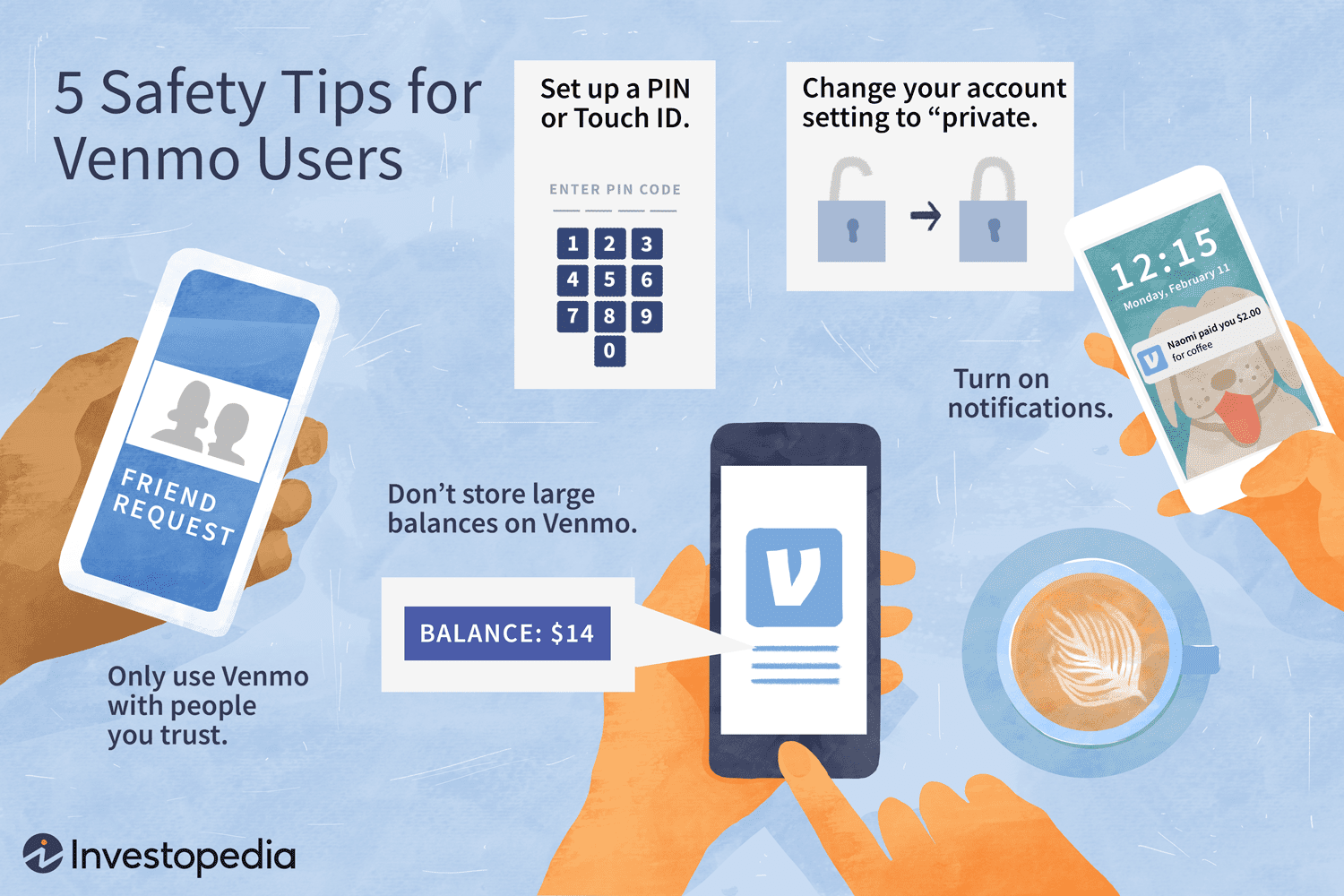
One of the first steps users should take to secure their accounts is to change their security settings to “Private,” which will cloak your transaction history. Otherwise, anyone, including strangers, will be able to view details of your transactions by clicking on your profile.
To combat hacking, users should also:
- Avoid keeping large amounts of money as a Venmo balance.
- Frequently transfer Venmo transactions to linked bank accounts.
- Only use Venmo to exchange funds with people you know.
Warning
Beware of scammers sending emails asking for your password or other personal information relating to your account. Venmo will never ask you for this information and urges users to send an email to [email protected] if confronted with suspicious activity.
A Comprehensive Guide to Venmo Fees
Opening a Venmo account is free, and there are no monthly fees. A simple Venmo transaction from a user’s bank account, Venmo debit card, or Venmo cash balance is free of charge. If a credit card is used to pay, Venmo charges the sender a 3% fee.
Some other services also carry charges:
Venmo Instant Transfer: Fees and Duration
You can use the Instant Transfer feature to move money from your Venmo account to any U.S. bank account or participating credit card account. There is a fee of 1.75% for Instant Transfer. “Instant” usually means 30 minutes or less.
You can avoid this fee by choosing the standard transfer option, which is free and takes three to five business days.
Credit Card Charges
Venmo introduced its own credit card in 2020, and it carries a variable but steep interest rate just like most other credit cards. The interest rate varies depending on the credit rating of the applicant. Cash advances cost the greater of $10 or 5% of the amount. Balances on cash advances carry an annual percentage rate (APR), which varies based on the Prime Rate.
The Venmo credit card comes with a cash-back feature of 3% on your “top spend” category, 2% on your second most-used category, and 1% on everything else.
Debit Card Charges
The Venmo debit card, issued in partnership with Mastercard, is free to use except for some ATM fees, which you can avoid if you’re careful.
ATM withdrawals are free from the MoneyPass network but cost $2.50 each from a domestic out-of-network ATM. Further, a $3 over-the-counter withdrawal fee applies when a signature is required for a withdrawal at a bank or financial institution. There are no annual or monthly fees, processing fees, or interchange fees. Merchants pay the transaction fees.
Tip
You can use your Venmo debit card free of fees as long as you don’t use it to withdraw cash from an out-of-network ATM and refill it only from your linked bank account or your Venmo balance.
The Revenue Model of Venmo
Venmo derives significant revenue from the per-transaction fees that it charges merchants. Thanks to PayPal’s infrastructure, Venmo is available at more than 2 million merchants.
Venmo charges merchants a 1.9% fee, plus 10 cents per transaction. Companies are willing to pay these rates due to the number of new customers Venmo brings to their doors. Venmo also offers participating merchants a higher social media profile.
Another stream of merchant revenue is derived from the Pay-With-Venmo button that can integrate into other apps for in-app purchases. For example, Uber allows its app users to pay for rides and Uber Eats using Venmo without leaving the Uber app. Uber pays Venmo a fee for each transaction.
Finally, Venmo makes money from consumers who pay for instant transfers or who use a credit card to fund their payments. Venmo also earns money from the Venmo credit card from interchange fees charged to merchants and from interest and fees charged to cardholders.
Evaluating Criticisms and Controversies Surrounding Venmo
Venmo has been criticized for its security, slow customer service responses to breaches, and failure to protect users’ privacy. These complaints have highlighted the app’s shortcomings. On the positive side, they have also forced the company to take measures to prevent future slip-ups and serve its customers better.
One notable settlement was reached in 2016 after a complaint from Texas Attorney General Ken Paxton accused Venmo of negligent privacy, safety, and security practices. The settlement included a $175,000 payment to the state as well as reforms to these practices.
In February 2018, Venmo reached a settlement with the Federal Trade Commission (FTC) concerning the company’s failure to disclose information to consumers about privacy settings. The FTC also found the company in violation of the Gramm-Leach-Bliley Act (GLBA) Safeguards Rule, which requires financial institutions to implement measures to protect the security, confidentiality, and integrity of customer information.
In January 2021, the Consumer Financial Protection Bureau (CFPB) began investigating Venmo’s treatment of scam victims, following complaints that the payment app had been threatening to send debt collectors to their homes. The probe included unauthorized funds transfers and how Venmo handled funds mistakenly sent to the wrong account. The probe closed in May 2024 with no enforcement action taken against Venmo or PayPal, but the CFPB continues to seek more in-depth regulation and oversight of payment apps.
How Long Does It Take to Send Money With Venmo?
Any money sent from one Venmo user to another should appear immediately in the recipient’s account. External bank transfers take from three to five days and are free. Instant Transfers to a bank account take less than an hour and cost 1.75% of the amount being transferred. Adding funds to your Venmo balance from your bank account can take three to five business days.
What Are the Risks of Using Venmo?
As with other online applications, there is a chance that your Venmo account could be hacked and your balance emptied. To avoid becoming a victim of theft:
- Don’t share your account information and password.
- Log out of your account when you’re not using it.
- Don’t store large amounts of money in a Venmo account.
- Don’t make payments to someone you don’t know.
- Avoid clicking on emails that might be phishing expeditions.
Is Venmo Insured by the Federal Deposit Insurance Corp. (FDIC)?
Unlike U.S. bank accounts, Venmo balances aren’t insured by the FDIC. This means that if Venmo goes bust or somehow loses your money, you won’t automatically be reimbursed. This suggests that Venmo users are better off keeping little or no money in the Venmo account and instead keeping it in the linked bank account where it can be tapped as needed.
Is Venmo Free?
Venmo is free to use for its original function, which was to send and receive money to and from friends and associates. It’s also free to use to pay participating merchants. However, if you use a linked credit card to pay anyone, you will be charged a 3% fee. There are also fees associated with Venmo credit cards and debit cards, as well as some bank transfers.
The Bottom Line
Venmo’s basic P2P transactions are free, but using a credit card or other services may incur fees. The platform has grown in popularity, expanding into merchant services and offering branded credit cards. Despite its convenience, Venmo remains vulnerable to security risks, such as hacking and theft. Users should monitor their transactions, change their passwords regularly, and use privacy settings to help secure their accounts.
