


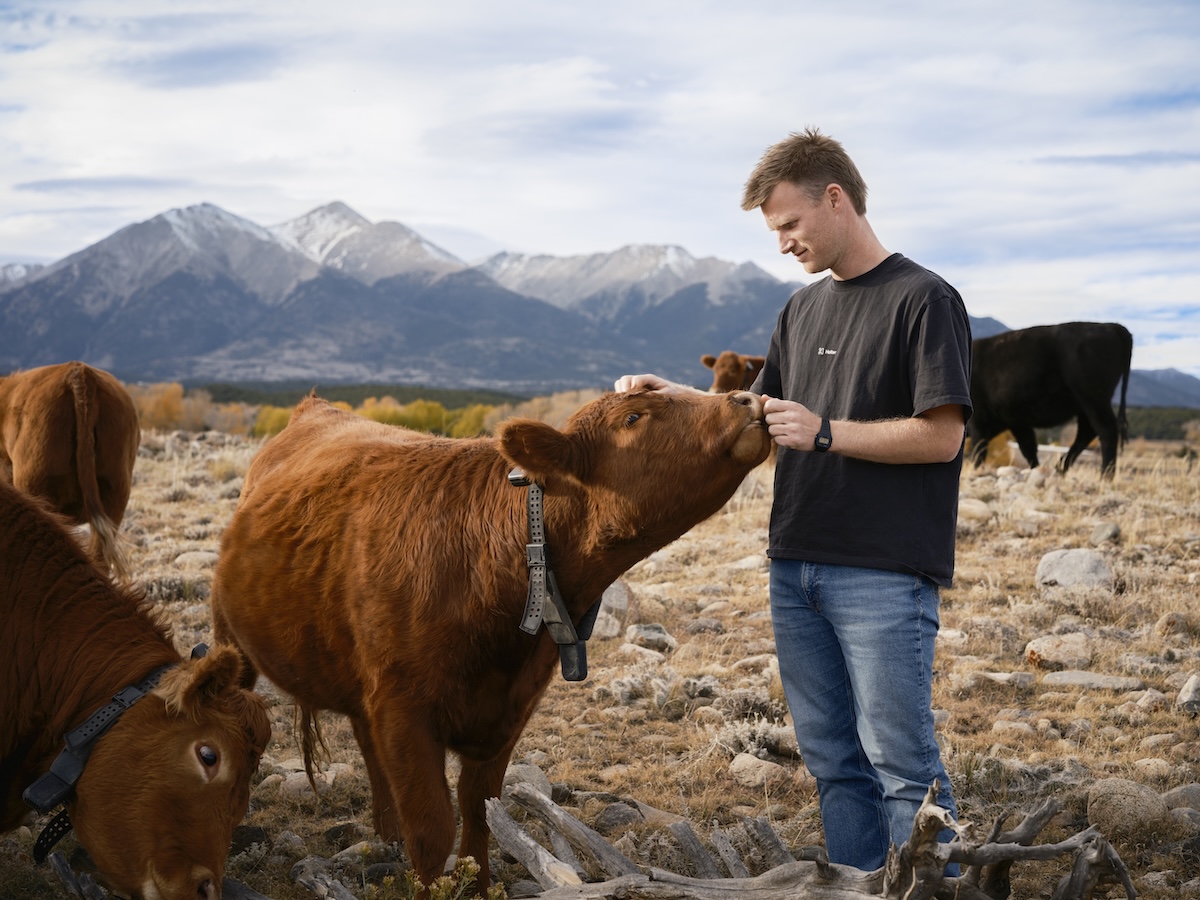
Founders Fund has made its name backing what Peter Thiel calls “zero to one” companies — businesses that don’t just improve on existing ideas but create something entirely new. Its portfolio includes Facebook, SpaceX, and Palantir. Its latest bet is a New Zealand startup that puts solar-powered smart collars on cows.
Halter, which closed a $220 million Series E at a $2 billion valuation last month, with Founders Fund leading the round, isn’t the kind of company that tends to dominate technology headlines. There is no agentic AI involved, no humanoid robots. There is, however, a very large and largely unsolved problem: How do you manage cattle spread across some of the most remote terrain on earth, without dogs, horses, motorbikes, or helicopters?
Craig Piggott, Halter’s 30-year-old founder and CEO, has spent nine years working on an answer. “If you manage a pasture-based farm, whether it’s dairy or beef, the most important variable is how you manage the productivity of your land,” Piggott told TechCrunch in a recent interview. “Fences are the lever — they control where animals graze and how you rest the land. Being able to do that virtually just made a lot of sense.”
The system Halter has built combines a solar-powered collar, a network of low-frequency towers, and a smartphone app to let farmers create virtual fences, monitor every animal around the clock, and move their herds without ever leaving the farmhouse. Cattle are trained to respond to audio and vibration cues from the collar — a process Piggott that likens to the way a car beeps as it approaches a wall while parking. Most animals, he says, learn within three interactions with a virtual fence. “Then you’re able to guide them and shift them around on sound and vibration alone.”
The collar does more than herd. Because it is always on and collecting behavioral data, it also tracks animal health, monitors fertility cycles, and flags when individual animals may be sick, capabilities that Piggott says have improved dramatically as Halter has accumulated what is likely the world’s largest dataset of cattle behavior. The company is now on its fifth generation of hardware, and its reproduction product is currently in beta with U.S. customers.
“The product that ranchers use today is radically different to what they bought a year ago,” Piggott said. “Every week, we’re releasing new things to our customers.”
Piggott grew up on a dairy farm in New Zealand before studying engineering and landing a brief stint at Rocket Lab, the rocket company that gave him his first glimpse of what a technology startup could be. “Rocket Lab was kind of my introduction to technology and startups and the world of venture capital,” he said. “Realizing you could raise money, hire a team, and chase an ambitious mission was inspiring. I wanted to do that in agriculture.” He started Halter at 21. “Probably a bit naive in hindsight,” he acknowledged, “but that was fine.”
Techcrunch event
San Francisco, CA
|
October 13-15, 2026
Nine years later, Halter’s collar is on more than a million cattle across more than 2,000 farms in New Zealand, Australia, and the United States, where the company operates in 22 states. The financial proposition for farmers is straightforward: By giving ranchers precise control over where their herds graze, Halter can lift the productivity of their land by as much as 20% — not by saving labor costs (though that happens, too), but by ensuring cattle graze more efficiently and leave less grass behind. “In some cases, we see customers literally doubling the output off their land,” Piggott said. “The upper ceiling for returns is very, very strong.”
Halter isn’t alone in spying the opportunity. Pharmaceutical giant Merck already makes its own virtual fencing system for cattle, called Vence, and newer entrants are circling too — at Y Combinator’s most recent “demo day,” a startup called Grazemate presented a vision for herding cattle with autonomous drones (no collars necessary).
Piggott seems unbothered by either. Asked about drones, he answers: “Can I see drones playing some small part in the future? Probably. But I don’t think a drone is the right form factor for the core fencing element of virtual fencing. A collar will probably be the right form factor for a very long period of time.” And as for the bigger competitive picture, he argues the real obstacle isn’t rival technology at all. “The biggest competition is just not changing anything,” he said. “It’s doing what you did last year.”
What sets Halter apart, Piggott argues, is the sheer engineering difficulty of what it has spent nine years solving — a system managing a thousand animals needs to be reliable to many nines of uptime, because even a 1% failure rate means ten animals out at any given time. “Chasing those many nines of reliability takes time,” he said, “and that long tail is what we proved out in New Zealand over many years before we started to expand globally.”
Halter is also something of an outlier in the agricultural technology sector, which has slumped in recent years as startups struggled to persuade farmers to adopt new products while managing high operational costs. Piggott attributes Halter’s traction to its relentless focus on financial return. “From day one, Halter has been built around a really strong financial ROI,” he said. “If you can lift the productivity of land by 20%, that flows through the entire business.”
Unlike most technology companies, Halter doesn’t view the United States as the center of its universe. “The U.S. market is important for us, but it’s not the world’s biggest market,” Piggott said. “Agriculture is spread around the world, and we need to get there too.” The company has now raised roughly $400 million in total and is prioritizing expansion across the U.S., South America, and Europe.
But the scale of the remaining opportunity is perhaps best captured in a single number — one that no doubt resonated with Founders Fund and Halter’s earlier backers, too. Halter’s collar is on one million cattle, while there are one billion more in the world. With less than 10% penetration in its home market of New Zealand alone, “We have a long way to go, and a lot of product still to build,” Piggott said.
You can listen to our conversation with Piggott on this newest episode of the StrictlyVC Download podcast, which drops Tuesdays.
