


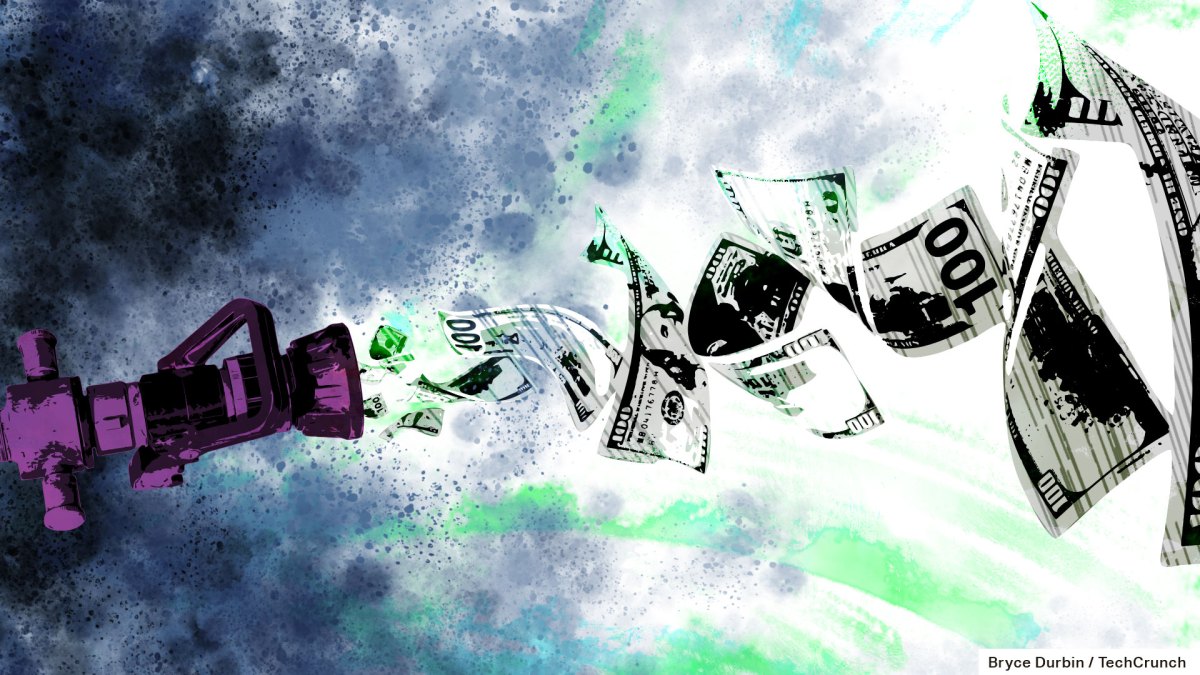
As competition among AI startups heats up, founders and VCs are turning to novel valuation mechanisms to manufacture a perception of market dominance.
Until recently, the most sought-after companies raised multiple rounds of funding in quick succession at escalating valuations. However, because constant fundraising distracts founders from building their products, lead VCs have devised a new pricing structure that effectively consolidates what would have been two separate funding cycles into one.
Recent rounds employing this scheme include Aaru’s Series A. The synthetic-customer research startup raised a round led by Redpoint, which invested a large portion of its check at a $450 million valuation, The Wall Street Journal reported. Redpoint then invested a smaller portion at a $1 billion valuation, and other VCs joined at that same $1 billion price point, according to our reporting. TechCrunch was the first to report Aaru’s financing, including its multi-tiered valuation.
The approach allows desirable startups like Aaru to call themselves a unicorn — valued at more than $1 billion — even though a significant portion of the equity was acquired at a lower price.
“It is a sign that the market is incredibly competitive for venture capital firms to win deals,” said Jason Shuman, a general partner at Primary Ventures. “If the headline number is huge, it’s also an incredible strategy to scare away other VCs from backing the number two and number three players.”
The massive “headline” valuation creates the aura of a market winner, even though the lead VC’s average price was significantly lower.
Multiple investors told TechCrunch that until recently, they had never encountered a deal where a lead investor splits their capital between two different valuation tiers in a single round.
Techcrunch event
San Francisco, CA
|
October 13-15, 2026
Wesley Chan, co-founder and managing partner at FPV Ventures, views this valuation tactic as a symptom of bubble-like behavior. “You can’t sell the same product at two different prices. Only airlines can get away with this,” he said.
In most cases, founders offer a discount to top-tier VCs because their involvement serves as a powerful market signal that helps attract talent and future capital.
But since these rounds are frequently oversubscribed, startups have found a way to accommodate the excess interest: Rather than turning away eager investors, they allow them to participate immediately, but at a significantly higher price. These investors are willing to pay that premium because it is the only way to secure a spot on a high-demand cap table.
Another startup that gave preferential pricing to its lead investor is Serval, an AI-powered IT help desk startup, according to The Wall Street Journal. While Sequoia’s lowest entry price was at a $400 million valuation, Serval announced in December that its $75 million Series B valued the company at $1 billion.
While the high “headline” valuation can help recruit talent and attract corporate customers who may view the company as having a stronger market position than its competitors, the strategy is not without its risks.
Even though the true, blended valuation for these startups is lower than $1 billion, they are expected to raise their next round at a valuation that is higher than the headline price; otherwise it will be a punitive down round, Shuman said.
These companies are in high demand now, but they may face unexpected challenges that will make it very hard for them to justify their high valuations. In a down round, employees and founders end up with a smaller ownership percentage of the company; they can also erode the confidence of partners, customers, future investors, and potential new hires.
Jack Selby, managing director at Thiel Capital and founder of Copper Sky Capital, warns founders that chasing extreme valuations is a dangerous game, pointing to the painful market reset of 2022 as a cautionary tale. “If you put yourself on this high-wire act, it’s very easy to fall off,” he said.
