


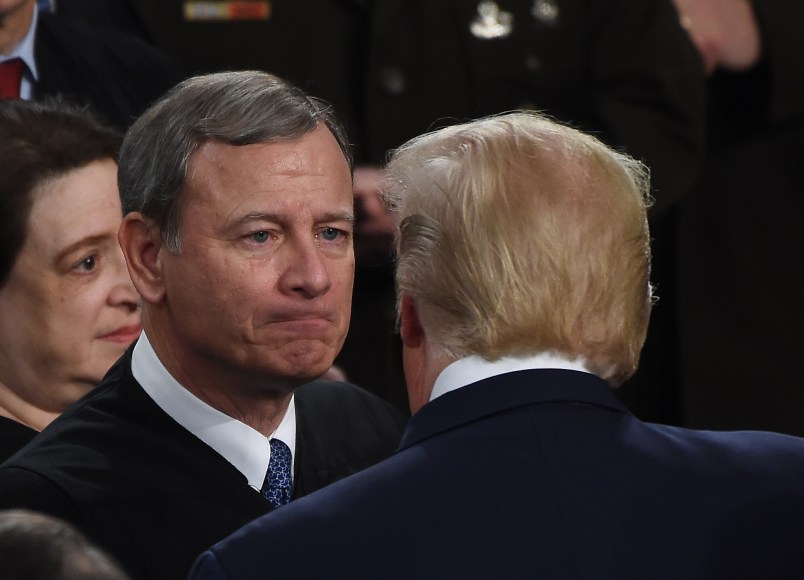
Back in May, a nonprofit with close ties to the Trump administration filed a curious lawsuit. It sued John Roberts and the body that operates the federal court system, dryly informing both the chief justice and the courts that they were mistaken in their belief that they controlled themselves: actually, the suit claimed, the White House controls them.
America First Legal Foundation, a nonprofit founded in 2021 by Stephen Miller to act as a MAGA version of the ACLU, concealed the claim in a FOIA lawsuit: it asked a judge to order the Administrative Office of U.S. Courts and the Judicial Conference of the United States, the bodies that manage the federal judiciary, to comply with a records request. To achieve that relatively humble ambition, America First wanted the judge to make a wide-reaching finding: that the court system is in fact managed by the executive branch, and is therefore subject to FOIA requests.
Roberts responded to this on Thursday, asking the judge to dismiss the case. He said what you might expect: that in fact he is the one who gets to manage the court system, not the White House.
In doing so, Roberts, represented in the case by Supreme Court legal counsel Ethan Torrey, made a few points familiar to those who have followed the fight over independent agencies. Congress acted very clearly, Roberts said: it gave the judiciary the authority to manage itself. Any argument to the contrary “is antithetical to Congress’s legislative purpose in creating those entities in the first place and should therefore be rejected.”
Elsewhere, Roberts pushes back against various claims America First made when arguing that other features of how the courts are constructed and run mean they should be considered a part of the executive branch.
Thursday’s filing is the kind of wholesale rejection of the claim that one might. expect. But it comes with some irony attached. Roberts and the Republican-appointed majority on the court have spent this year rejecting similar arguments when applied to independent executive branch agencies. As they’ve dismissed those arguments, granting more power to President Trump, they’ve carved out exceptions that make sense practically but which legal experts criticize as incoherent: the National Labor Relations Board may not be an independent agency, the court ruled in May, but the Federal Reserve is. (The conservative majority provided little legal reasoning for how this could be, and, in a dissenting opinion, Justice Elena Kagan archly noted “the creation of a bespoke Federal Reserve exception” among a host of agencies that had, to that point, been considered similarly under the law.)
It goes to the trollish nature of the lawsuit itself. In this case, America First Legal was asking Roberts to apply the logic that had been used to decimate executive branch independent agencies to the agencies that manage the judiciary and, by extension, to himself. In another case, America First Legal used a similar FOIA claim to argue that the Government Accountability Office, a legislative branch agency, is actually an executive branch agency.
In the background of all this is the administration’s ongoing campaign to intimidate the court system. It spent the first several months of the administration flouting court orders in high-profile cases and subverting them in lesser-noticed ones. As TPM documented, DOGE threw a wrench in court operations and sent out mass emails to judges and other court staff demanding a list of their weekly accomplishments.
When I showed the lawsuit to a series of law professors and other experts in this area in May, they reacted with a mixture of derision and horror, but emphasized one thing: the claim was as ridiculous as it was trollish. But, they said, its source — a nonprofit with close ties to the White House — and its aping of right-wing legal thought made it hard to ignore.
