


Quick context before the detail: could this southeast asian country be the best place to retire? sits at the intersection of a few real-world decisions most readers face at some point. Here is a clear summary of what is going on, and why it matters.
Editor’s note: This article is part of an ongoing series on retiring abroad. To see all the articles in the series, jump to the end.
Long gone are the days when Vietnam was solely associated with a prolonged war that embroiled the U.S., splitting it in two politically, and giving rise to the 1960s counterculture, an enduring mistrust of government, and the modern mass protest movement. With the U.S. taking the side of anti-communist South Vietnam against North Vietnam, the war that began in 1955 saw public opposition to U.S. involvement rise to 60% by 1970. The war ended with the humiliating spectacle of the fall of Saigon in 1975, but the country reunified the following year.
That dark time was more than half a century ago, and though the infamously controversial and destructive war has not been banished from the memories of the baby boomers and Gen Xers who lived through it, this demographic is now more likely to bring up the day they spent on a junk in Halong Bay while on a Seabourn cruise than the Tet Offensive of 1968.
Sign up for Kiplinger’s Free E-Newsletters
Profit and prosper with the best of expert advice on investing, taxes, retirement, personal finance and more – straight to your e-mail.
Profit and prosper with the best of expert advice – straight to your e-mail.

Vietnam’s tourism has been on a tear for years, recently reporting 35.7% growth in international visitors; the U.S. is one of the country’s top five feeder markets. Flight bookings to the Vietnamese city of Nha Trang (actually Cam Ranh International Airport) between 2024 and 2025 place the country in the top 15 emerging summer destinations, beating out popular Iceland and Japan. Nha Trang is renowned for its white sand beaches and diving.
The days of Vietnam taking a backseat to perennial Asian favorites like Thailand are fading, so it makes sense that the country, which hugs the east coast of the Indochinese peninsula (and is bordered to the west by Laos and Cambodia), is primed to spark the imaginations of retirees looking to relocate. Their reasons are varied: exciting cities, serene beaches, dramatic scenery and biodiversity, adventure, culture, cuisine, and the enticing cost of living, which is approximately 59.3% lower than in the U.S., with rental prices about 78.5% lower.
In addition, the country boasts both sultry tropical regions (southern and central Vietnam) — and temperate areas (in the north) that experience the four seasons. That’s quite a lot to recommend this 1,000-mile-long, exotic S-shaped country. If you want to consider Vietnam for your golden years, a tourist visa affords you three months to look around. If you think Vietnam is for you and you need more time to nail things down, you can apply for an extension during those 90 days — the short-term goal is to obtain a Temporary Residence Card (TRC).
Note that Vietnam, which self-designates as socialist (with increasingly capitalistic tendencies), is essentially a communist state. On the plus side, though Vietnam is still part of the developing world, poverty has decreased and urbanization, economic growth and diversification, and investment in high-tech industry have all increased.

Visa matters
Vietnam doesn’t offer a designated retirement visa, but there are other ways to plant your beach chair here, specifically through business investment. “Vietnam’s DT Investor Visa has emerged as one of Southeast Asia’s most structured pathways for foreign entrepreneurs and investors seeking to establish a presence in the country’s dynamic economy,” says Dr. Laura Madrid Sartoretto, research lead at the global intelligence unit of Global Citizens Solutions. “A major advantage of the DT Investor Visa is its alignment with Vietnam’s broader strategy to foster high-value economic development.”
Sartoretto explains that Vietnam’s DT visa system offers “a graduated series of options,” which includes the very reasonable DT3 and DT4 types:
- DT1: Investment: approximately $4 million — for a duration of up to 5 years
- DT2: Investment: approximately $2 million — up to 5 years
- DT3: Investment: approximately $120,000 — up to 3 years
- DT4: Investment: approximately $120,000 — up to 12 months
Foreigners can obtain these visas by establishing a new company, investing in an existing Vietnamese enterprise, or contributing to sectors identified as strategically important. “Beyond business ownership,” Sartoretto explains, “the DT visa enables holders to participate actively in their own enterprise, granting legal work authorization linked directly to their investment activity.”
The other qualifications are pretty basic: You must be officially retired in your home country, you must hold valid health insurance, you are required to be financially independent and can support yourself and your family during your allowed stay in Vietnam, and you must not have any criminal charges or sentencing for serious crimes.
Finally, “investors are permitted to sponsor their spouses and dependent children for residence in Vietnam, ensuring that families can relocate together,” Sartoretto says.

Health care and taxes
as reported by Sartoretto, Vietnam’s healthcare system ranks 63rd out of 191 countries in the WHO’s overall health system performance assessment. “Vietnam offers a blend of public and private health care,” she explains, “with the public system providing widespread basic care and an expanding network of modern, internationally accredited private hospitals in major cities catering to expats and those seeking higher-quality, English-speaking medical services.”
For expats and retirees, she adds, “annual private health insurance in Vietnam typically ranges from $500 to $1,500 per year, depending on age, health status, and coverage level; this investment grants access to top-tier private hospitals, shorter wait times, and comprehensive services that meet or exceed Western standards, mainly in big cities.”
Good news, tax-wise: “Although Vietnam is a worldwide tax system, in practice, foreign pension income that is remitted to Vietnam by foreign retirees is rarely taxed,” Sartoretto says. “This is due to the absence of explicit provisions regarding the taxation of overseas pensions for foreign retirees. Most retirees report that their pension income from abroad is not subject to Vietnamese tax, as long as it is simply remitted for personal living expenses.”

(Image credit: Getty Images)
Where to retire in Vietnam
Sartoretto says that the largest expat communities are found in Ho Chi Minh City (Saigon), Hanoi and the central coastal city of Da Nang. “In these cities, expats can rent a modern, furnished one-bedroom apartment in the city center for $350 to $650 per month, or $200 to $400 in less central neighborhoods,” she says. on “buying” property, because only long-term leaseholds are available in Vietnam, expats may shy away from trying to own their homes.
The southerly Ho Chi Minh City, with its selection of Chinese and French colonial architecture, is the financial and economic nerve center of Vietnam. The country’s most populous city contains a wealth of public parks, and tourists and locals are drawn to the restaurants, bars, coffee shops and general street life of Bui Vien Walking Street. Ho Chi Minh City is also home to Tan Son Nhat International Airport, Vietnam’s largest airport. It takes roughly six hours to drive from the city to Nha Trang’s stunning beaches, but note that Vietnam’s well-regarded train system shoots up and down the coast.
As dense and popular as Ho Chi Minh City is, Hanoi, in the north, receives even more visitors. Like Ho Chi Minh City, Hanoi is an economic powerhouse that is rapidly modernizing, with a dazzling skyline and Western businesses in evidence. With 1,000 years of history, Hanoi is filled with cultural sites and boasts a night market and a walkable Old Quarter. It takes less than three hours to drive from Hanoi to the wondrous limestone rock formations that dot Halong Bay.
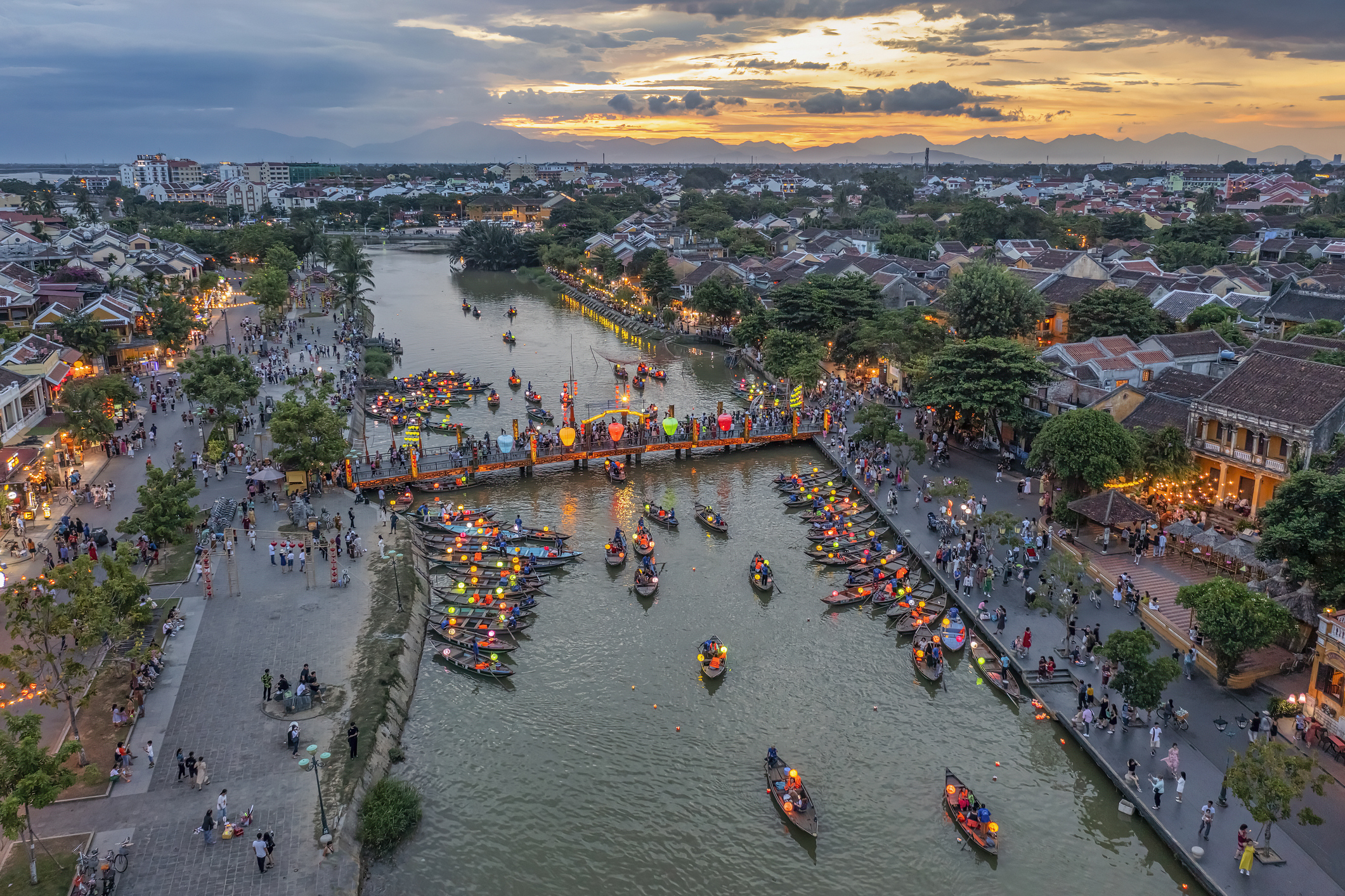
Finally, Da Nang, located on the central coast, is another modern city, but one that offers access to mountains and caves to explore, and several UNESCO World Heritage Sites. Non Nuoc Beach is lined with resorts, from a pricey (for Vietnam) Marriott composed of 122 villas featuring private pools to local boutique hotels that offer sleek rooms and amenities for less than $100/night (e.g. TMS Hotel Da Nang Beach). InterContinental, Hyatt, and Novotel are also represented in Da Nang.
